
Pokémon Ex-generation serial variant rarity
This blog post is a deep-dive into an interesting part of the Pokémon ex-era card generation. There are 16 expansions in this generation. In most of these expansions the common and uncommon rarity cards included multiple serial numbers, creating alternate versions of the cards:
Ruby & Sapphire, Sandstorm, Dragon, Hidden Legends, Team Rocket Returns, Deoxys, FireRed & LeafGreen, Emerald, Unseen Forces, and Delta Species.
Each version is documented and photographed on TopVault. All 1450+ of these cards can be browsed.
A great summary and discussion of these cards originated on efour: Complete List of ex era Serial Code Numbers. This is thanks to the many contributors, @pfm, @tonysandlin, and others across related threads, through whose efforts the complete set of serials was mapped out.
That post documents all known serials found on ex-era cards. The interesting aspect of these serials is that a specific card may have one or more alternative serials. In this case the Pikachu #72 from Sandstorm has serials 3AP-WH8-431, 3AP-WH8-JTR, 3AP-WH8-7J9. We can consider these alternative serials as card variations.
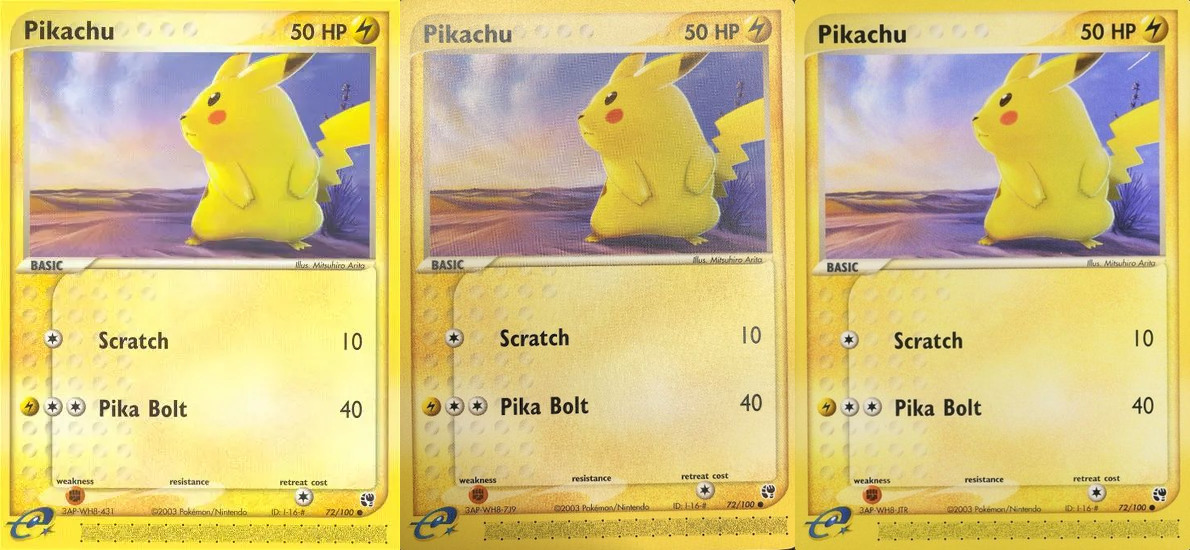
I became interested in learning more about the meaning of the serials and started collecting as many as I could. (Link to that initial analysis)
There are a few properties that others have collectively discovered:
Only commons and uncommon rarities have variant serials.
An uncommon rarity alternate serial may match its reverse holo version.
Some series may only have alternate serials for common rarities (i.e., Emerald).
The suffix (last three characters) is the only part that changes.
The pairs of suffixes for a card repeat and are always grouped together.
An example of (2) is the FireRed & LeafGreen Haunter and its alternative serial, the alternative serial matches the reverse holo.
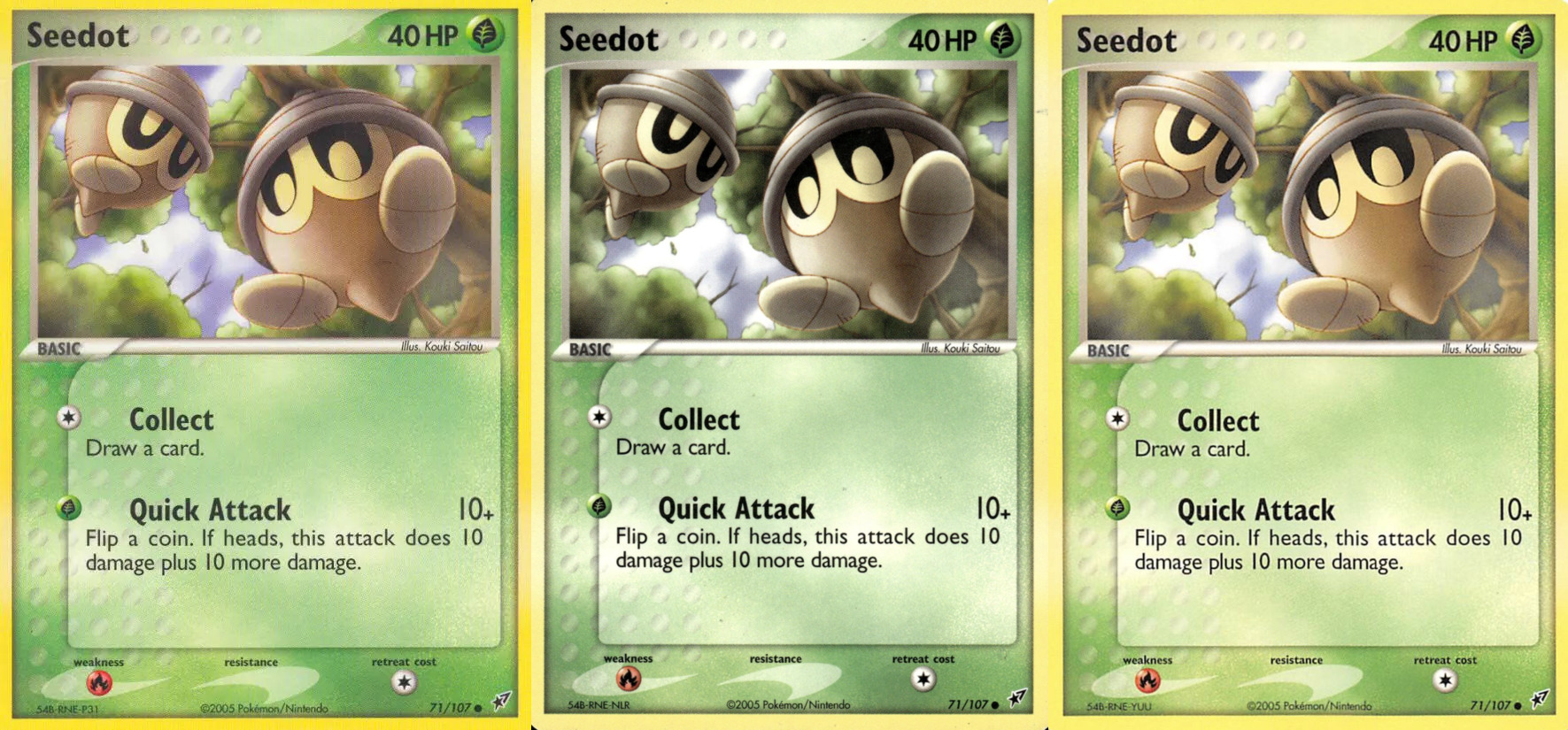
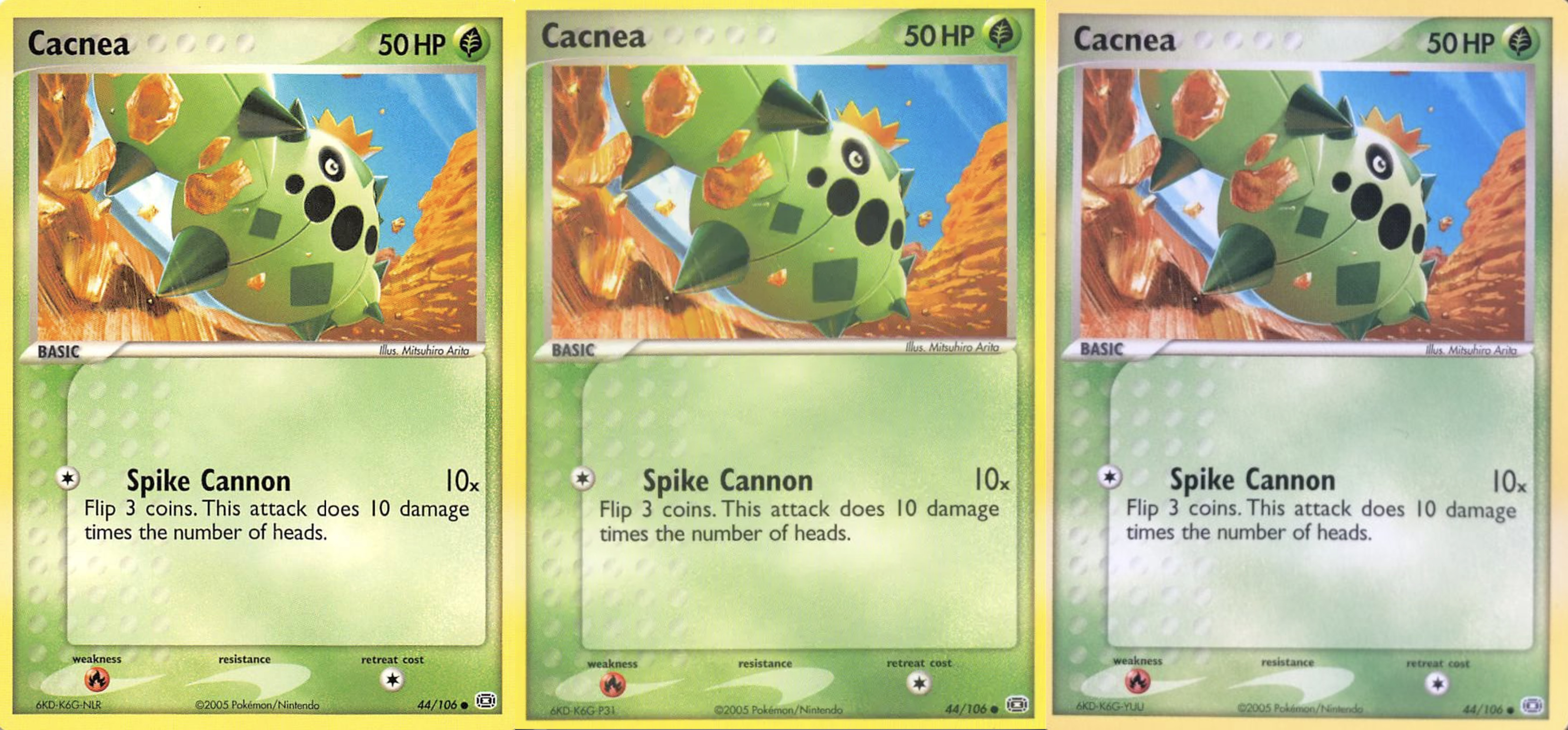
And property (4) means that for FireRed & LeafGreen Haunter #34 the prefix ZNL-7RF- is the same on its variations. Property (5) means that for a group of suffixes like NLR, P31, YUU, each time a card has one of these suffixes it will also have the others. For example Seedot #69 in Deoxys and Cacnea #44 in Emerald share this suffix group.
Are some serials more rare?
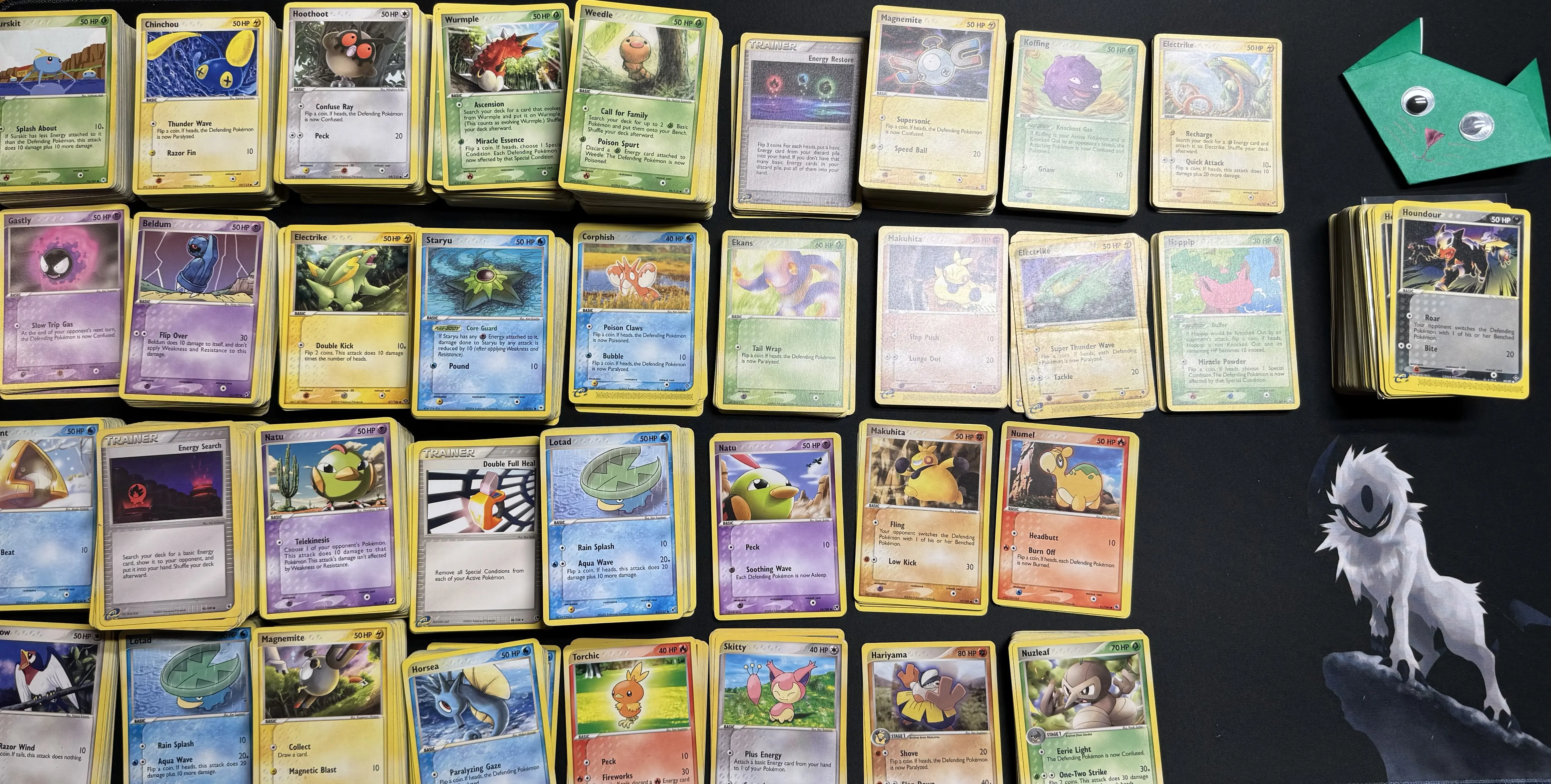
This is what I explored the most with my analysis. I created an experiment to acquire English cards from different areas around the US and count the frequency of serials. I also looked for evidence of multiple serials appearing in the same booster boxes and theme decks.
I will conclude with some additional properties based on my observations:
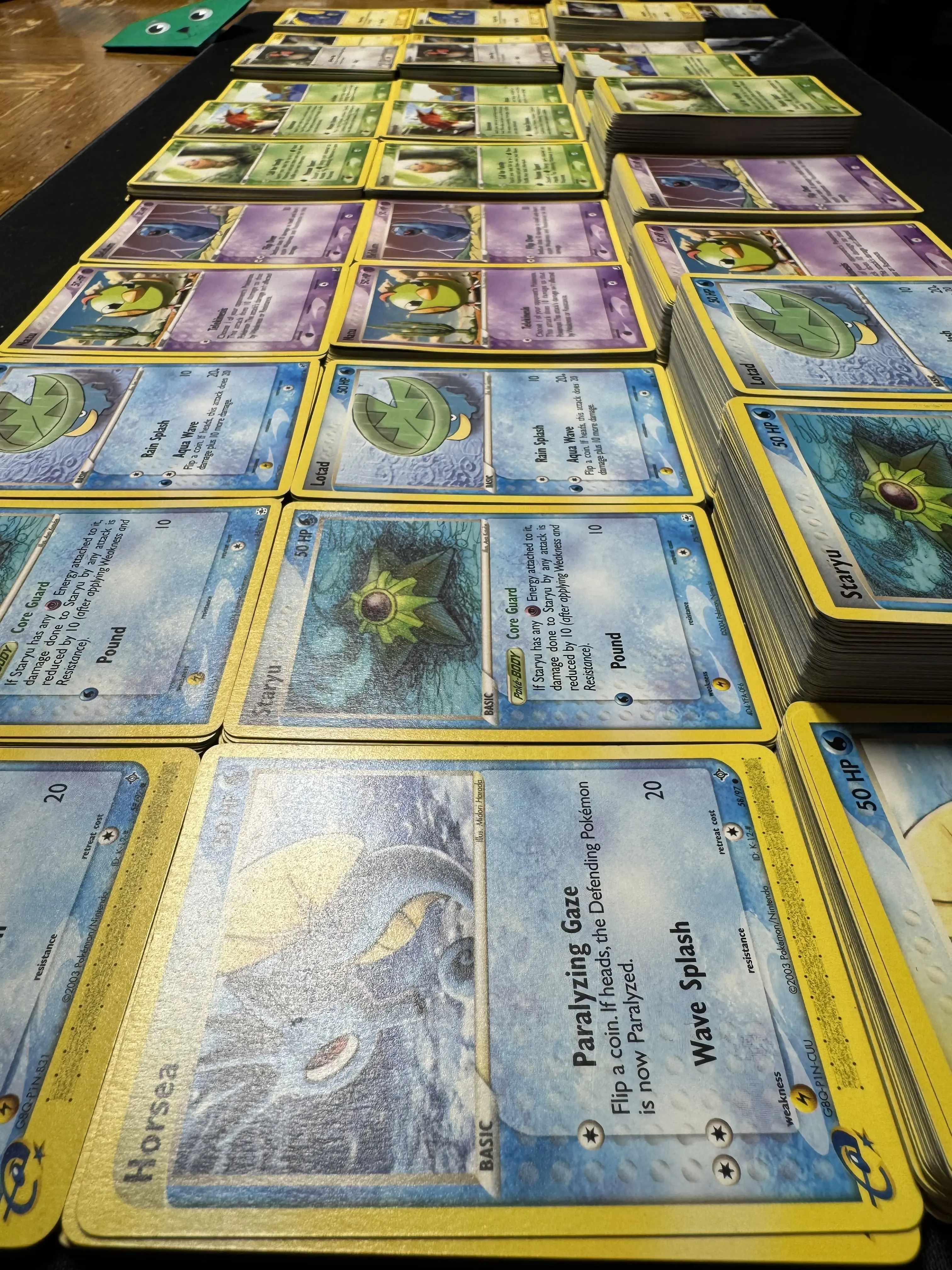
A. For a given theme deck all copies of a card have the same serial number.
B. A sealed booster box may contain multiple serial variants of the same card.
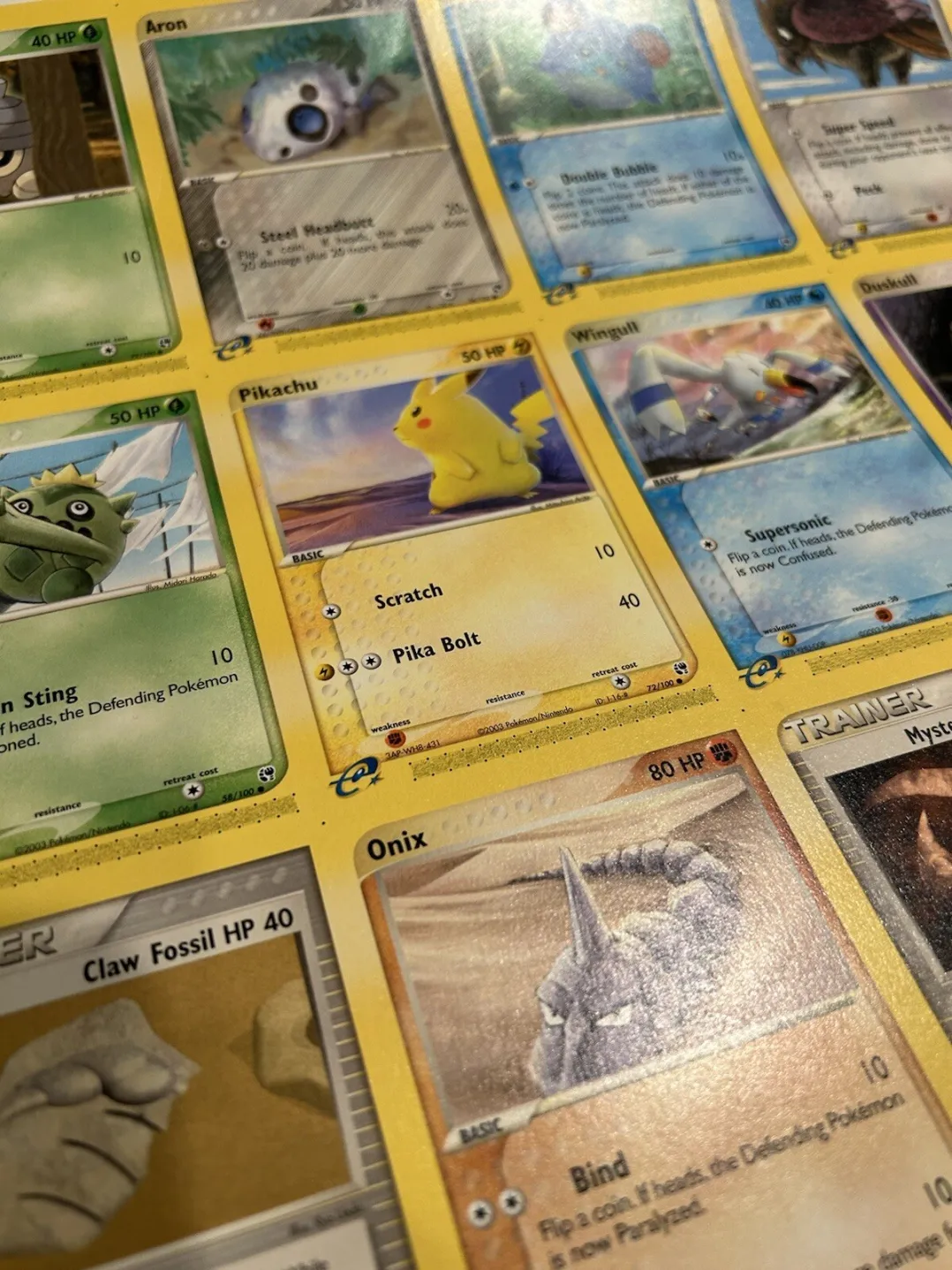
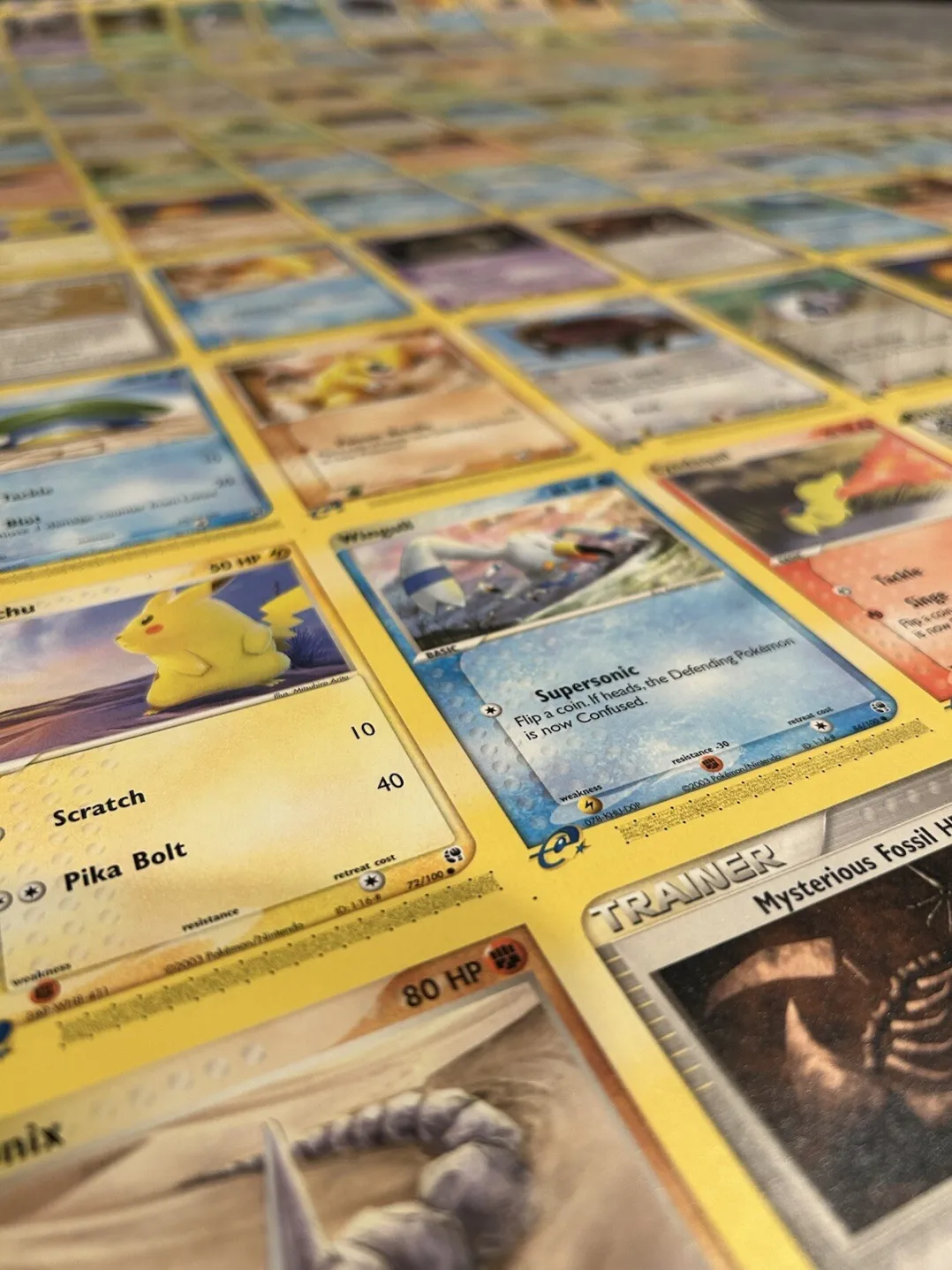
C. Limited examples of uncut sheets show the same serial repeating (example below).
D. For cards not included in a theme deck the frequency of serials includes a less-common outlier.
E. Specific cards have a variant that is much less common, sometimes with very elusive evidence of the serial existing.
In the following table I will summarize the counts of cards (total over 1450) I selected to collect. The serials will be in order of frequency, where the most frequently occurring serial is first. A card will be marked (*) if it does not appear in a theme deck. If a card does appear in a theme deck, the first serial will be the non-exclusive variant included in the deck.
| Card | Serial A | Serial B | Serial C |
|---|---|---|---|
| Magnemite #74 / Delta Species | 3ZU-URY-MLG / 46 (68%) | 3ZU-URY-BNZ / 11 | 3ZU-URY-E3L / 10 |
| Wurmple #82 / Deoxys* | R57-NP9-FTR / 43 (52%) | R57-NP9-HJ9 / 20 | R57-NP9-5E5 / 19 |
| Lotad #63 / Deoxys | J3L-HY3-MW1 / 84 (88%) | J3L-HY3-CXZ / 8 | J3L-HY3-NQX / 6 |
| Beldum #55 / Deoxys | 8VT-4J3-MW1 / 65 (80%) | 8VT-4J3-NQX / 10 | 8VT-4J3-CXZ / 6 |
| Nuzleaf #43 / Deoxys | 516-PJ3-G43 / 30 (88%) | 516-PJ3-53A / 4 | |
| Electrike #60 / Deoxys | P5Q-3WN-C66 / 10 (77%) | P5Q-3WN-NB5 / 2 | P5Q-3WN-P0P / 1 |
| Horsea #58 / Dragon | G8Q-P1N-JCR / 34 (77%) | G8Q-P1N-CUU / 6 | G8Q-P1N-B31 / 4 |
| Corphish #52 / Dragon | 2ZR-3H7-D0P / 15 (94%) | 2ZR-3H7-83X / 1 | 2ZR-3H7-7QG / 0 |
| Electrike #47 / Emerald | AM1-4LY-6QG / 37 (88%) | AM1-4LY-HTD / 4 | AM1-4LY-4PY / 1 |
| Snorunt #64 / Emerald | 1PK-1EY-D31 / 34 (77%) | 1PK-1EY-SJ9 / 6 | 1PK-1EY-N9R / 4 |
| Taillow #68 / Emerald* | PDR-C7E-GUU / 12 (52%) | PDR-C7E-ZTR / 11 | PDR-C7E-EK1 / 0 |
| Weedle #86 / FireRed & LeafGreen | WT9-5G9-GF6 / 104 (69%) | WT9-5G9-FB5 / 25 | WT9-5G9-B0P / 21 |
| Magnemite #68 / FireRed & LeafGreen | 1KJ-GH7-40P / 69 (83%) | 1KJ-GH7-SQG / 7 | 1KJ-GH7-K3X / 7 |
| Surskit #76 / Hidden Legends | R3F-UC7-D0P / 55 (82%) | R3F-UC7-83X / 5 | R3F-UC7-7QG / 7 |
| Staryu #75 / Hidden Legends | 4D4-YFA-LPX / 88 (88%) | 4D4-YFA-9G3 / 6 | 4D4-YFA-0F6 / 6 |
| Energy Search #90 / Ruby & Sapphire | PLL-2GK-40P / 98 (93%) | PLL-2GK-SQG / 4 | PLL-2GK-K3X / 3 |
| Energy Restore #81 / Ruby & Sapphire | 0Q7-NP9-DGB / 17 (89%) | 0Q7-NP9-NR6 / 2 | |
| Makuhita #56 / Ruby & Sapphire | KKE-Z1E-GUU / 13 (68%) | KKE-Z1E-EK1 / 3 | KKE-Z1E-ZTR / 3 |
| Double Full Heal #86 / Sandstorm | RL4-H9A-8AG / 41 (82%) | RL4-H9A-S6Z / 9 | |
| Ekans #55 / Team Rocket Returns | MT1-DLF-MW1 / 15 (54%) | MT1-DLF-CXZ / 8 | MT1-DLF-NQX / 5 |
| Koffing #61 / Team Rocket Returns | BAQ-X9N-3UU / 20 (67%) | BAQ-X9N-631 / 5 | BAQ-X9N-VTR / 5 |
| Hoppip #57 / Team Rocket Returns | 2NW-GF7-40P / 11 (79%) | 2NW-GF7-K3X / 2 | 2NW-GF7-SQG / 1 |
| Chinchou #52 / Unseen Forces* | PFS-JZ2-GF6 / 33 (40%) | PFS-JZ2-B0P / 21 | PFS-JZ2-FB5 / 17 |
| Hoothoot #59 / Unseen Forces* | EJB-SN9-GF6 / 35 (41%) | EJB-SN9-FB5 / 28 | EJB-SN9-B0P / 23 |
| Natu #63 / Unseen Forces | 2QS-TZH-40P / 57 (74%) | 2QS-TZH-SQG / 12 | 2QS-TZH-K3X / 8 |
Within this list the Wurmple, Taillow, Chinchou, and Hoothoot cards are the ones not appearing in any theme deck. Comparing their frequencies to the others, one pattern emerges in that the most frequent serial’s suffix is consistent across both groups (theme deck and non-theme deck). Though for the former group the statistical significance is low confidence.
Other observations from collecting this data are that the stock photo used for each card is not consistent among the serial groups, nor is the stock photo the most commonly occurring variant.
In all cases, there is a clear (at least a +7% difference) most-frequent-serial for any given card.
And an example of the same serial appearing in an uncut sheet, again the Pikachu #72 from Sandstorm with serial 3AP-WH8-431:
What does the analysis mean?
At the very least, there is a “rarity” factor based on serial occurrence. Some of these serial variations are much more difficult to find.
If you have any of these cards, check the serial variation you own! You may have one of the less-frequently occurring variants.
If you are a “must complete them all” type collector, then you’ll definitely want one of each. And this is especially true if you like collecting every card of your favorite Pokémon, now you have a new challenge.
So what do the serials mean?
While there are many questions remaining, this is the most interesting. Are the serials corresponding to different factories where cards were printed, to different print runs, or something else? Are there meanings to the serials, perhaps some unsolved puzzle?
If you find that something was left out of this analysis, or have a potential idea about the serial meanings, please feel free to reach out at [email protected] or @t5trades on Instagram.